
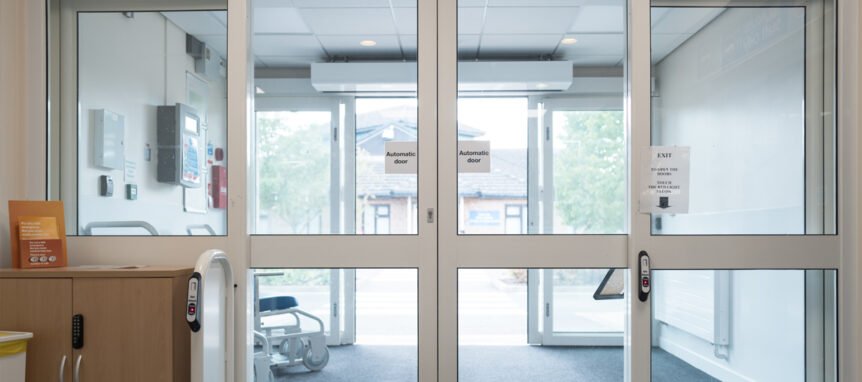
Automatic doors provide convenient, accessible entry for customers, employees, patients, and visitors. In busy commercial buildings, they may operate hundreds or even thousands of times throughout the day. With that amount of use, components can gradually wear, shift out of adjustment, or develop problems that affect how the door responds.
Automatic door problems are not always caused by a single component. Sensors, operators, tracks, hardware, alignment, and electrical connections all work together to keep the system functioning correctly. Recognizing common warning signs can help businesses arrange professional service before a minor issue develops into a more disruptive failure.
The Door Does Not Open When Someone Approaches
One of the most noticeable automatic door problems occurs when the system fails to detect someone approaching. This may be related to a sensor that is dirty, obstructed, damaged, or improperly positioned. Sensor calibration can also affect how effectively the system detects movement or presence within the activation area.
In other situations, the problem may involve the automatic operator, electrical components, or another part of the system. Because several components can produce similar symptoms, professional inspection is the best way to identify the actual cause.
The Door Opens or Closes Too Slowly
Automatic doors are designed to move at controlled speeds that support safe and convenient access. If a door suddenly begins moving much more slowly than usual, it may indicate mechanical resistance, operator problems, worn components, or an issue with the door’s alignment.
A door that has shifted slightly may require the operator to work harder during every cycle. Continuing to operate the system without correcting the underlying problem can increase wear and potentially lead to additional repairs.
The Door Closes Too Quickly
An automatic door that closes faster than expected can create a safety concern, particularly in high-traffic environments or locations frequently used by individuals with limited mobility. Improper settings, sensor problems, or issues with the automatic operator may contribute to unexpected closing behavior.
Changes in closing speed should be professionally evaluated rather than ignored. Proper adjustment helps ensure the door provides enough time for people to move safely through the entrance.
The Door Opens Without Anyone Nearby
Automatic doors that open unexpectedly may have a problem with sensor positioning, sensitivity, or calibration. Movement outside the intended detection area can sometimes activate a sensor if it is not properly adjusted.
Environmental factors may also contribute to unwanted activation in some situations. A technician can inspect the sensor coverage area and determine whether adjustments or repairs are necessary to restore consistent operation.
The Door Does Not Close Completely
An automatic door that remains partially open can affect security, indoor comfort, and energy efficiency. The problem may result from an obstruction, misalignment, worn hardware, sensor issues, or a mechanical problem preventing the door from completing its cycle.
Even a small gap can allow conditioned air to escape and outdoor heat or humidity to enter. If the door also fails to secure properly, the issue can become a building security concern after business hours.
The Door Makes Unusual Noises
Automatic commercial doors should generally operate smoothly without excessive grinding, scraping, squeaking, or other unusual sounds. New noises often indicate that something within the system is no longer moving as intended.
Worn rollers, loose hardware, alignment problems, or mechanical components may be responsible. Ignoring unusual noises can allow the underlying issue to worsen, potentially increasing wear on surrounding parts of the system.
The Door Operates Inconsistently
Intermittent problems can be particularly frustrating because the door may function normally during one cycle and fail during the next. Inconsistent operation may be related to sensors, electrical connections, controls, operators, or other components.
Because the issue may not be immediately visible, professional troubleshooting is often necessary. Identifying the source early can reduce the chance of the entrance becoming completely unusable at an inconvenient time.
Heavy Traffic Can Accelerate Automatic Door Wear
Commercial entrances that experience constant traffic place additional demands on automatic door systems. Sensors and operators must respond repeatedly throughout the day, while mechanical components experience continuous movement.
Regular maintenance becomes especially important for retail stores, healthcare facilities, offices, and other busy properties. Preventative inspections can identify developing problems before they interfere with normal traffic flow or accessibility.
Regular Maintenance Helps Prevent Unexpected Problems
Automatic door maintenance provides an opportunity to inspect sensors, operators, hardware, alignment, and other important components. Adjustments can be made when necessary, and worn parts can be addressed before they contribute to a larger system failure.
Business owners and employees should also pay attention to changes in how an automatic door sounds, moves, or responds. Small differences in everyday operation can provide an early indication that professional service is needed.
Keeping Automatic Commercial Doors Operating Reliably
Automatic door problems can affect accessibility, safety, security, and the overall experience of entering a commercial building. Whether a door is moving too slowly, failing to close, making unusual noises, or responding inconsistently, identifying the cause early can help prevent additional wear and unnecessary disruption.
For more information about automatic door inspection, maintenance, or repair services, contact Apex Door Solutions. Apex Door Solutions helps businesses maintain safe, accessible, and dependable automatic door systems for reliable everyday operation.